
About the conference
The European Commission's Directorate-General for Migration and Home Affairs (DG HOME) and the European Investment Bank (EIB) organised the fi-compass flagship AMIF conference 'Policy and practice: Financial instruments supporting integration of third-country nationals in the EU', on Friday, 28 June 2024, in Brussels, Belgium.
The fi-compass AMIF flagship conference aimed to:
- Outline the major EU policy objectives related to using and implementing financial instruments that support the integration of Third-Country-Nationals (TCNs) in the European Union (EU)
- Stimulate exchange and discussion on the advantages, features and general suitability of financial instruments in delivering the Asylum, Migration and Integration Fund (AMIF) objectives
- Present the key findings of the fi-compass AMIF study. This includes areas related to TCN integration with the most potential for support through financial instruments, the respective financing gaps and potential design options for financial instruments or combination of financial instruments and grants to address these needs
- Showcase examples of financial instruments that support TCN integration
- Discuss how both grants and financial instruments can support this area
- Inform stakeholders about the fi-compass advisory support to Member States and managing authorities, as well as further support options.
Panel sessions with question-and-answer opportunities and dedicated networking time allowed for strong interaction among attendees.
Presentations
Access to finance in the area of integration of TCNs: Study results
Access to finance in the area of integration of TCNs: Panel discussion
Lessons learnt from the use of financial instruments in Cohesion Policy and using the opportunities of combination with grants under shared management Funds – Panel discussion
Financing migrant integration through financial instruments – Examples beyond shared management Funds
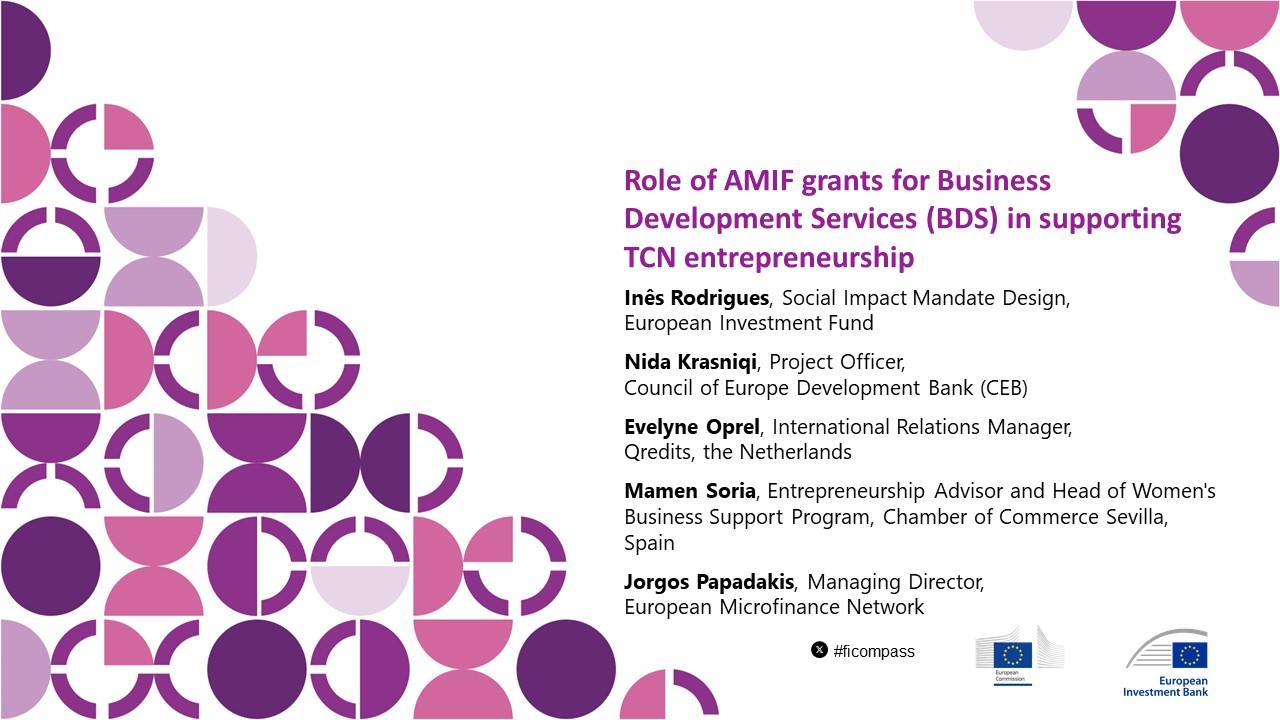
Role of AMIF grants for Business Development Services (BDS) in supporting TCN entrepreneurship
Background
Efficient and comprehensive management of migration flows from third countries is one of the top priorities of the European Union. AMIF is the key EU fund to specifically address migration priorities and challenges.
The setting up and the implementation of National Programmes are subject to the application of the Common Provisions Regulation (CPR, Regulation EU 2021/1060), which provides the possibility to use AMIF resources through financial instruments, e.g. loans, guarantees, equity. The CPR also provides broad opportunities to combine financial instruments and grants.
Financial instruments under shared management Funds already successfully support a number of EU policies such as the Cohesion Policy and the Common Agricultural Policy. Using financial instruments provides many benefits and they are seen as a smart way to use public funds. Thanks to their revolving nature and leverage effect, they can create greater impact in the economy than traditional non-repayable forms of support, therefore allowing to do more with less.
To allow the use of AMIF resources for financial instruments to support the integration of TCNs, Member States need to programme these in their National Programmes. This is still possible with 2021-2027 AMIF resources.
The dedicated AMIF workstream of the fi-compass platform, provided by the European Commission’s Directorate-General for Migration and Home Affairs (DG HOME) in partnership with the European Investment Bank (EIB) provides managing authorities, public authorities on local, regional and national level, financial intermediaries and all other stakeholders involved in programming of resources and implementation of projects for migrants horizontal and tailored advisory on the use of the financial instruments in the area of integration of migrants under the AMIF but also under other resources, for instance ESF+ and the InvestEU Social Investment and Skills Window.
The centrepiece of the fi-compass support is a suite of documents available to the stakeholders involved in migrant integration measures:
- fi-compass factsheet ‘Asylum, Migration and Integration Fund (AMIF) – Financial instruments’
- fi-compass Practical guide part 1 ‘Setting up financial instruments supporting migrant integration’
- fi-compass Practical guide part 2 ‘Setting up financial instruments supporting migrant integration’ (to be published soon),
- fi-compass AMIF market study ‘The potential for financial instruments supporting migrant integration’ (to be published soon),
- fi-compass EaSI BDS pilot case study (to be published soon).
Equipped with these tools, policy decision-makers in the area of integration of TCNs in the EU, AMIF managing authorities and other key stakeholders can progress their considerations if and how to implement financial instruments under AMIF and other resources to support integration of TCNs in the EU.
Pictures








Related resources
Part 1 of this fi-compass study provides a market assessment, including an analysis of the demand and supply side for financing in the area of integration of third-country nationals (TCNs) in the EU. The study focusses on three specific areas: microfinance, housing and social impact assessment. It is based on desktop research and a number of online and in-person exchanges with the key stakeholders in this area.
Part 2 of this fi-compass study discusses the key recommendations for financial instruments, potentially combined with grants, to support the integration of third-country nationals (TCNs) in the EU. The study focusses on three specific areas: microfinance, housing and social impact assessment. It is based on desktop research and a number of online and in-person exchanges with the key stakeholders in this area.
This fi-compass factsheet introduces the potential use of financial instruments in the area of early stage and long-term integration of migrants in the EU.
It describes how the Asylum, Migration and Integration Fund (AMIF) financing may be deployed for the first time through financial instruments such as loans, guarantees and equity, to support relevant objectives of this EU policy area.
This fi-compass practical guide aims to assist Asylum, Migration, and Integration Fund (AMIF) Managing Authorities and other stakeholders as they begin exploring the use of financial instruments to support third-country nationals' integration in the EU.
It explains how shared management financial instruments work and who can benefit from their support.

Subscribe to receive notifications of training, learning and networking opportunities/events.